
Quick Answer
The short answer
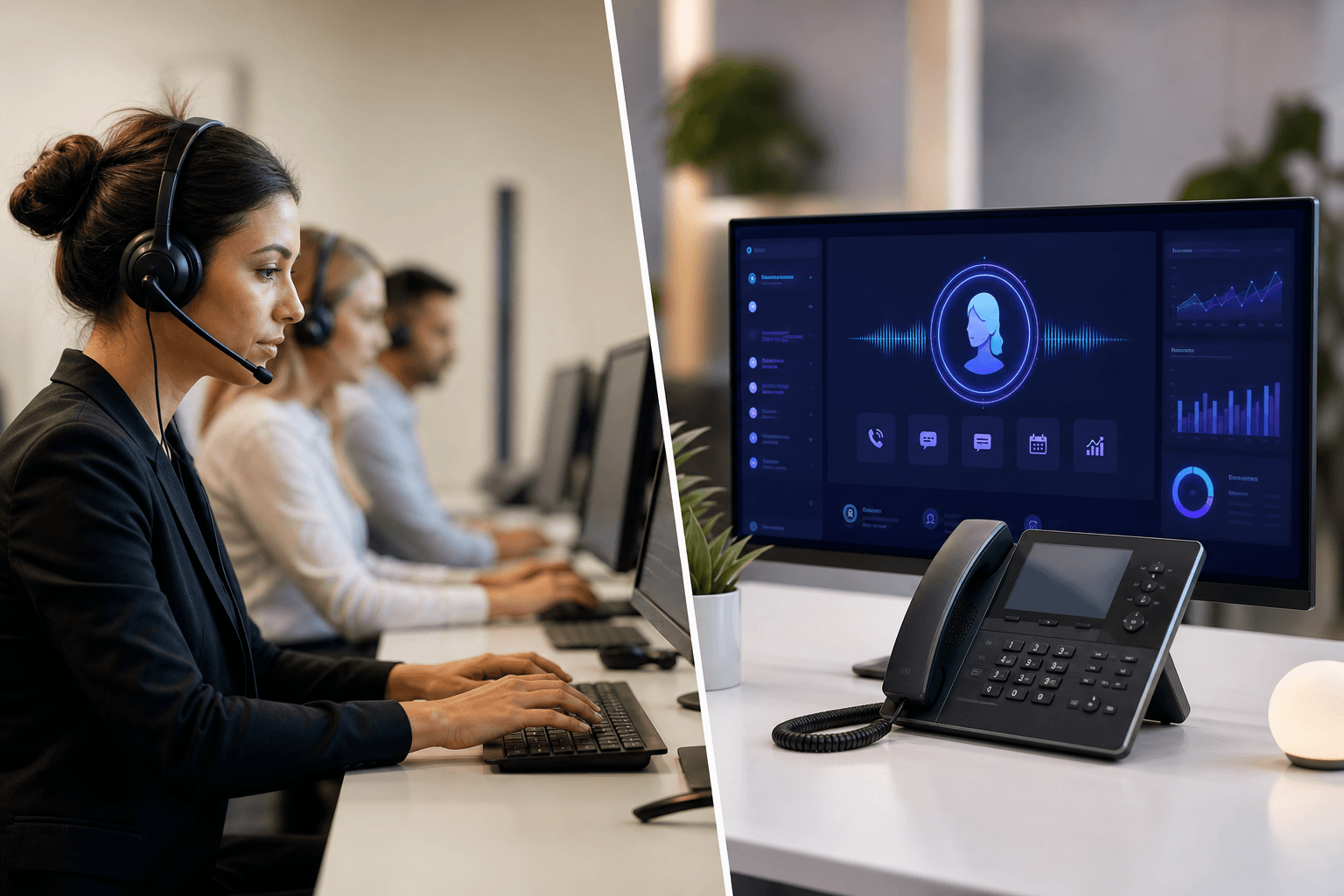
Traditional answering services use human operators who take messages. AI receptionists use software to have real conversations, capture structured data, and deliver instant summaries. For most service businesses, AI wins on cost, speed, and data quality.
When small business owners start losing leads to missed calls, two solutions come up most often: a traditional answering service or an AI receptionist. Both promise to answer your phones when you can't. But the experience your callers have — and the data you get afterward — are very different.
How Traditional Answering Services Work
Traditional answering services employ human operators who answer calls on behalf of multiple businesses. When your call is routed to them, an operator picks up, reads your script, takes a message, and often sends you an email or text with the caller's details. Quality varies significantly depending on the operator, the service level you pay for, and how busy the call center is at that moment.
How AI Receptionists Work
An AI receptionist is software that conducts real phone conversations using natural language processing. It answers instantly, follows a conversation flow you define, asks follow-up questions based on what the caller says, and delivers a structured lead summary to your team the moment the call ends. It doesn't get tired, it doesn't have off days, and it never puts a caller on hold.
The Cost Comparison
Traditional answering services typically charge $100–$400/month for basic coverage, with per-minute charges that can escalate significantly. AI receptionists generally cost $30–$150/month for unlimited calls. For small businesses with moderate call volume, the savings are significant — and the AI delivers better data per call.
Never miss a call. Never miss a customer.
Set up AI call answering for your business in under 10 minutes.
Start free trial on iOS →On desktop? Try the live AI call demo.
When a Traditional Answering Service Still Makes Sense
There are scenarios where human operators are preferred: highly sensitive calls that require empathy (medical emergencies, bereavement services, legal matters), calls where a human presence is part of your brand promise, or businesses where calls frequently involve complex branching scenarios that are hard to script. For most service businesses, these scenarios are the exception, not the rule.
The Verdict
For service businesses focused on lead capture, appointment scheduling, and 24/7 coverage, AI receptionists deliver more consistent results at a lower cost. The structured data they produce (versus a human's typed message) is also significantly more useful for follow-up and CRM integration.
Side-by-side comparison
| Feature | Traditional Answering Service | AI Receptionist |
|---|---|---|
| Availability | Business hours (usually) | 24/7/365 |
| Response time | 30 sec – 2 min | Instant (< 1 sec) |
| Cost (monthly) | $100 – $400+ | $30 – $150 |
| Lead data quality | Basic message taking | Structured: name, phone, need, address, urgency |
| Consistency | Varies by operator | Identical every call |
| Languages supported | English only (usually) | 100+ languages |
| Integration with CRM | Rare | Common |
| Setup time | Days to weeks | Under 5 minutes |
| Scalability during peak | Limited by operator count | Unlimited |
Frequently Asked Questions
Can I use both an answering service and an AI receptionist?
Yes — some businesses use AI for initial intake and after-hours coverage, then route complex calls to human agents during business hours. Hybrid setups are becoming more common.
Are callers less satisfied talking to an AI?
Research is mixed, but the data increasingly shows that callers care more about response speed than whether they reach a human. An AI that answers in one second beats a human answering service that puts them on hold.
What happens if the AI doesn't understand the caller?
Modern AI receptionists are trained to handle unrecognized inputs gracefully — they ask clarifying questions or offer to connect the caller to a human. You can also configure a fallback transfer option for calls the AI can't resolve.
Related Articles
Business Tips
What Is an AI Receptionist? How It Works, Costs, and Best Use Cases
An AI receptionist is AI phone answering software that answers calls, captures leads, summarizes conversations, and helps small businesses never miss a customer.
Business Tips
How Much Does an AI Receptionist Cost? 2025 Pricing Guide
AI receptionist pricing ranges from $30 to $500/month depending on call volume and features. Here's what you actually get at each price tier — and how to choose.

Business Tips
The Real Cost of a Missed Call for Small Businesses
Most small business owners underestimate how much a missed call actually costs. The math is sobering — and the solution is simpler than you think.