
Quick Answer
Call Center Glossary: 10 Terms Explained for Small Businesses
This call center glossary defines the terms small business owners meet when comparing phone coverage: call routing, call queues, ACD, IVR, contact centers, AI phone agents, lead intake, speed to lead, after-hours answering, and emergency dispatch intake.
Best for
- · small business owners
- · teams comparing call centers and AI answering
Key use cases
- · look up a term
- · compare phone coverage options
What Is Call Routing?
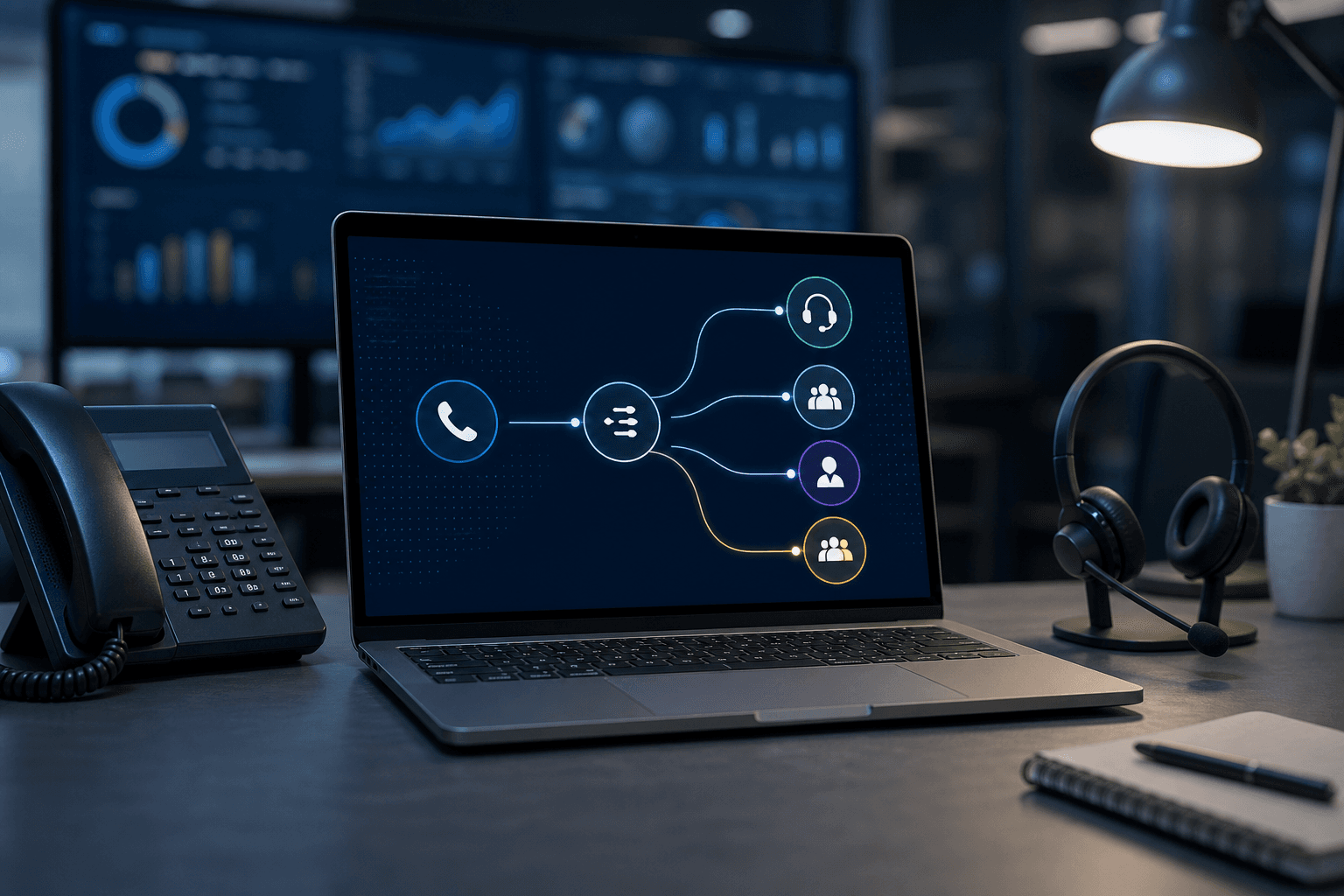
Call routing is the process of sending inbound calls to the right person, number, voicemail, answering service, or AI workflow based on time, availability, caller need, or business rules. A rule can look at the number dialed, the caller's number or location, the time of day, the day of the week, or who is available. On a small business line, a simple rule is conditional forwarding, where the AI picks up only if nobody answers within 2 to 3 rings.
Related reading
- What is an AI receptionist?
Start with the core definition before comparing industry workflows.
- Missed call statistics for small businesses
A citation hub for missed-call behavior, voicemail abandonment, and speed-to-lead.
- What makes MagicLine different
How MagicLine turns calls into customizable service workflows.
What Is a Call Queue?
A call queue holds callers in line until an agent is free. Queues exist because a team of agents can only take so many calls at once. An AI call center removes the queue by answering every call on the first ring, including several at the same time.
Related reading
- Answering service vs AI receptionist
Compare human answering services, virtual receptionists, and AI call answering.
- The real cost of a missed call
Use the revenue math to understand why fast call capture matters.
What Is Automatic Call Distribution?
Automatic call distribution (ACD) routes incoming calls to the most appropriate agent or queue. An ACD system picks the next agent by a set method, and skills-based routing adds a match between the caller's need and what each agent knows. A business with no agent pool has little use for ACD, because an AI that answers every call has nobody to distribute calls to.
- Linear: always starts from the top of the agent list
- Circular: continues from the next agent in order
- Uniform: goes to the agent who has handled the fewest calls
- Simultaneous: rings all available extensions at once
- Weighted: follows configured weights, such as different skill sets
What Is an IVR?
An IVR (interactive voice response) is an automated phone menu that routes callers using keypad or voice input, as in 'press 1 for sales'. Companies also use IVR for self-service tasks such as checking a balance or getting order information. An AI phone agent replaces the fixed menu with a conversation: the caller says what they need and the AI asks the next useful question.
What Is a Contact Center?
A contact center handles customer interactions across channels: phone, text, chat, and email. A call center is the phone-only version, used for receiving or making a large volume of calls. Inbound centers handle support and information requests, and outbound centers mostly place sales calls. An AI contact center automates these interactions with software instead of routing every one to a human agent.
What Is an AI Phone Agent?
An AI phone agent is software that can answer, understand, and respond to phone calls using natural language. MagicLine's agent greets callers with your business name, captures their name, number, and need, then creates a summary and task. It supports English, Spanish, and 100+ languages.
Related reading
- What is an AI receptionist?
The same idea applied to a small business front desk.
Never miss a call. Never miss a customer.
Set up AI call answering for your business in under 10 minutes.
Start free trial on iOS →On desktop? Try the live AI call demo.
What Is Lead Intake?
Lead intake is the process of collecting the information needed to qualify, prioritize, and follow up with a prospective customer. The fields depend on the trade. A contractor asks about project type, address, timeline, insurance status, and budget range, and a plumber asks about active leaks and water shutoff.
Related reading
- Best answering service for contractors
What to capture on an estimate call.
What Is Speed to Lead?
Speed to lead measures how quickly a business responds after a potential customer reaches out. To track it, record the time between the first call and the first useful response. Sorting callbacks by urgency, location, and job value helps the team spend that time on the right leads first.
What Is After-Hours Answering?
After-hours answering is call coverage that handles customer calls when a business is closed, busy, or unavailable. That covers nights, weekends, and holidays. A good setup records the caller's name, phone number, need, urgency, service area, and preferred time.
Related reading
- 24/7 call answering for small businesses
How to get round-the-clock coverage without hiring.
What Is Emergency Dispatch Intake?
Emergency dispatch intake captures the details needed to decide whether a service call requires immediate response. For a plumber that means active flooding and water shutoff status. For an HVAC company it means no-AC or no-heat symptoms and whether a vulnerable resident is in the home.
Related reading
- Best AI receptionist for plumbers
Includes an emergency plumbing intake checklist.
Contextual internal links
Frequently Asked Questions
What is the difference between a call center and a contact center?
A call center handles phone calls. A contact center adds other channels such as text, chat, and email.
What is the difference between ACD and a call queue?
ACD decides which agent gets the next call. A call queue is where callers wait until that agent is free.
Is an IVR the same as an AI phone agent?
No. An IVR offers a fixed menu of options. An AI phone agent holds a conversation and captures the details in a summary.
Sources
Never miss another call
Magicline answers every call 24/7. Try it free for 3 days, then $29.99/month.
Related Articles

Business Tips
What Is an AI Call Center? How It Works, Costs, and Benefits
An AI call center is software that answers, understands, and handles inbound phone calls automatically — greeting callers, capturing their needs, answering questions, booking appointments, and translating conversations in real time — without a queue, hold music, or a team of human agents. Unlike a traditional call center, it answers instantly 24/7, handles unlimited simultaneous calls, and supports 100+ languages at a flat monthly price.

Comparison
AI Call Center vs Traditional Call Center: Cost, Coverage, and Quality
An AI call center answers every call instantly 24/7, handles unlimited simultaneous calls, and includes 100+ languages for a flat monthly price. A traditional call center relies on hired agents, shift scheduling, and separate multilingual staff, so it costs more and still misses calls during peaks and after hours. For small and multi-location businesses, an AI call center delivers comparable coverage at a fraction of the labor cost.
Business Tips
What Is an AI Receptionist? How It Works, Costs, and Best Use Cases
An AI receptionist is AI phone answering software that answers calls, captures leads, summarizes conversations, and helps small businesses never miss a customer.