
Quick Answer
AI receptionist vs virtual receptionist
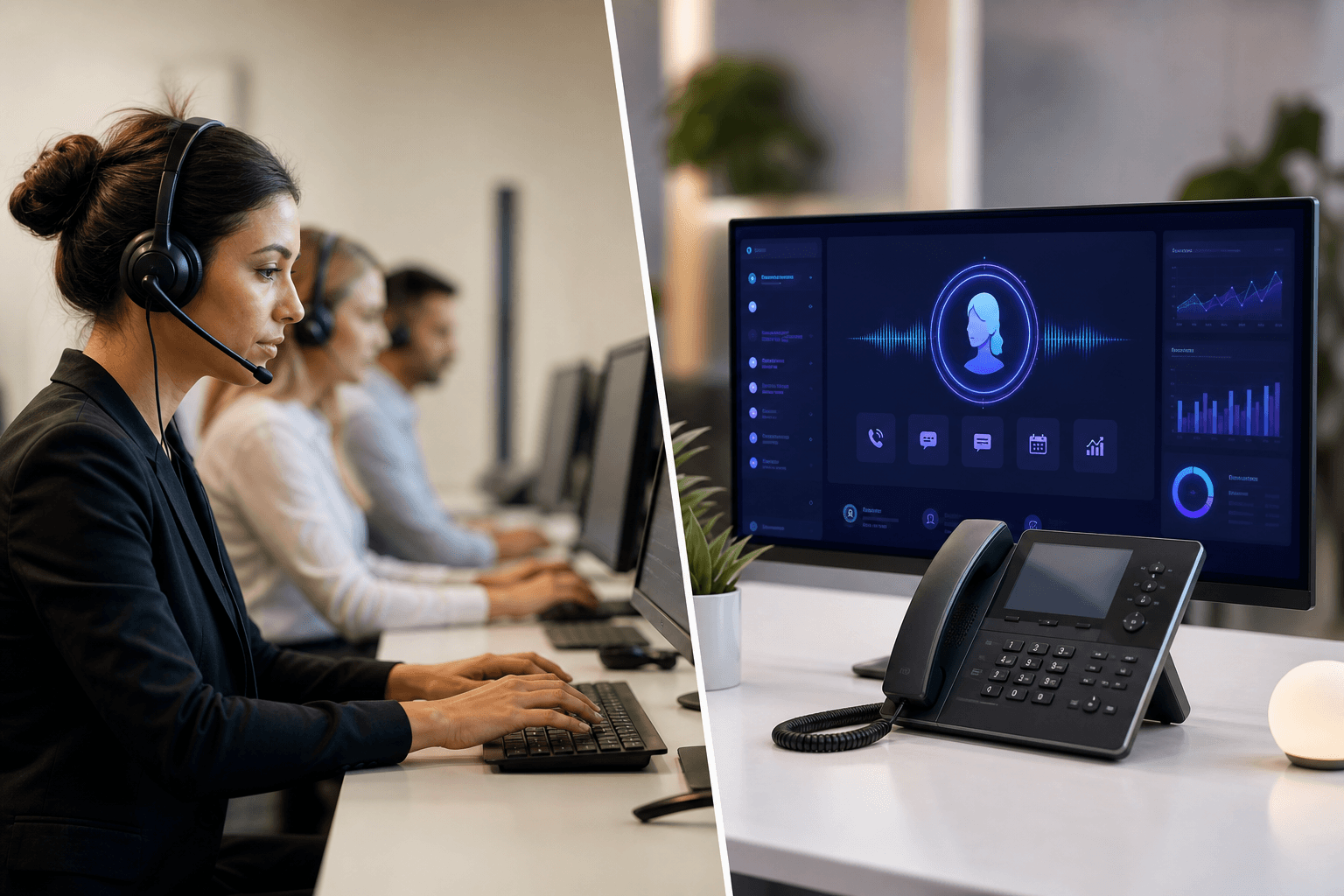
A virtual receptionist is a remote human who answers calls during set hours, usually billed per minute or per call. An AI receptionist answers instantly 24/7, handles unlimited simultaneous calls, captures structured intake automatically, and costs a flat monthly rate. For most small businesses focused on never missing a call, an AI receptionist delivers more coverage for less money.
Best for
- · solo operators
- · home services
- · high call-volume small businesses
- · anyone who needs 24/7 coverage on a budget
Key use cases
- · 24/7 answering
- · after-hours and overflow
- · structured lead capture
- · predictable flat pricing
"AI receptionist vs virtual receptionist" is one of the most common comparisons small business owners research when they realize voicemail is costing them customers. Both answer your phone so you don't have to — but they work very differently, cost very differently, and fit different needs. Here's a clear breakdown to help you choose.
Related reading
- Not sure what an AI receptionist is yet?
Start with the basics.
What is a virtual receptionist?
A virtual receptionist is a trained remote human who answers your calls off-site — taking messages, answering FAQs, and transferring calls during set hours. Services like Ruby and Smith.ai are well known. The strength is human judgment; the trade-offs are cost (typically $250–$800/month), per-minute or per-call billing, and limited availability unless you pay for premium 24/7 coverage.
What is an AI receptionist?
An AI receptionist is a software phone agent that answers calls with a natural voice, asks industry-specific intake questions, captures structured details, and sends you a summary — automatically, 24/7. It answers instantly, handles unlimited calls at once, and costs a flat monthly rate with no per-minute charges.
Related reading
- How does an AI receptionist work?
A step-by-step walkthrough of the call flow.
Cost: flat monthly vs per-minute
Cost is usually the deciding factor. Virtual receptionist services bill per minute or per call, so a busy month can get expensive fast and unpredictable. An AI receptionist like Magicline is a flat $29/month regardless of call volume — which makes budgeting simple and rewards you for capturing more calls instead of penalizing you.
📊 Typical monthly cost
Rough monthly ranges for each option:
- ·AI receptionist: ~$29/month flat, unlimited calls
- ·Virtual receptionist: $250–$800/month, often metered
- ·Part-time human hire: $1,500–$2,500/month plus overhead
Never miss a call. Never miss a customer.
Set up AI call answering for your business in under 10 minutes.
Start free trial on iOS →On desktop? Try the live AI call demo.
Coverage and capacity
A human can only take one call at a time and works set hours. When two customers call at once — or someone calls at 9pm on a Saturday — a virtual receptionist on a standard plan may miss it. An AI receptionist answers every call simultaneously, around the clock, so after-hours and overflow calls (often 30–40% of volume) are never lost.
Which should you choose?
Choose a virtual receptionist if your calls frequently need nuanced human judgment, you handle sensitive conversations that benefit from a person, and you have the budget for premium coverage. Choose an AI receptionist if your priority is never missing a call, you want structured intake on every conversation, and you want predictable flat pricing. Many businesses also start with AI for 24/7 capture and escalate the calls that truly need a human.
Related reading
- See Magicline's AI receptionist
24/7 answering, industry intake, flat pricing.
Contextual internal links
Side-by-side comparison
| Category | AI Receptionist (Magicline) | Virtual Receptionist |
|---|---|---|
| Who answers | AI voice agent | Remote human operator |
| Availability | 24/7/365 | Business hours (24/7 often premium) |
| Answer speed | Under 1 second, every call | Depends on operator availability |
| Simultaneous calls | Unlimited | Limited by staffing |
| Pricing model | Flat monthly (from $29/mo) | Per-minute or per-call ($250–$800/mo typical) |
| Intake output | Structured summary + next step | Message or note (varies) |
| Industry workflows | Built-in per industry | Script-dependent |
| Languages | 100+ automatically | Depends on staff |
| Human judgment on edge cases | Escalates to you | Strong |
Frequently Asked Questions
What is the difference between an AI receptionist and a virtual receptionist?
A virtual receptionist is a remote human answering calls during set hours, usually billed per minute or call. An AI receptionist is software that answers instantly 24/7, handles unlimited simultaneous calls, captures structured intake automatically, and costs a flat monthly rate.
Is an AI receptionist cheaper than a virtual receptionist?
Usually, yes. AI receptionists start around $29/month flat with unlimited calls, while virtual receptionist services typically run $250–$800/month and often bill per minute or per call.
Can an AI receptionist replace a virtual receptionist?
For most small businesses focused on capturing every call with structured intake, yes. Businesses that need frequent human judgment on complex or sensitive calls may prefer a human service, or use AI for 24/7 capture and escalate specific calls to a person.
Do virtual receptionists work 24/7?
Some do, but 24/7 human coverage is usually a premium upgrade. An AI receptionist is 24/7 by default, including nights, weekends, and holidays, at no extra cost.
Which is better for a small business?
For most small businesses where missing a call means losing a job, an AI receptionist offers more coverage for less money. A virtual receptionist is better when human judgment on every call is essential and the budget allows.
Sources
- Magicline AI receptionist overview
- BrightLocal: Small business consumer call survey
Related Articles
Business Tips
Answering Service vs AI Receptionist: A Real Comparison
Traditional answering services and AI receptionists both claim to solve missed calls. Here's an honest comparison across cost, quality, availability, and what happens to your leads.

Business Tips
AI Receptionist vs. Hiring a Receptionist: The Real Cost Comparison for Small Businesses
Thinking about hiring someone to answer your phones? Here's a straight comparison of what a human receptionist costs vs. an AI — and what you actually get for your money.
Business Tips
What Is an AI Receptionist? How It Works, Costs, and Best Use Cases
An AI receptionist is AI phone answering software that answers calls, captures leads, summarizes conversations, and helps small businesses never miss a customer.